
The “Alignment Trap”: When Monologues Drown “Dissent” (Part 1)

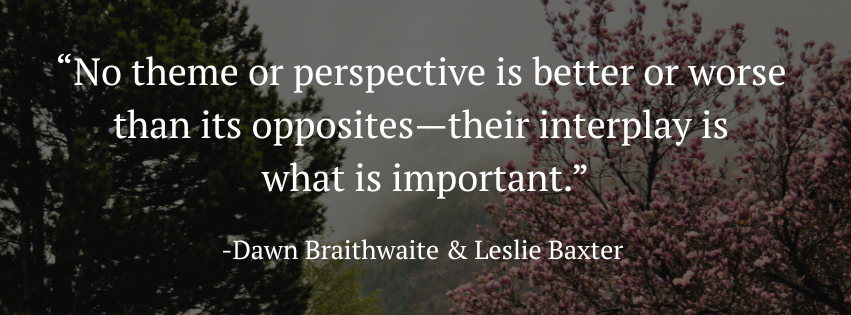
Whether you’re a stepparent, a change leader, or both (God bless you), you know the feeling of being pulled between polar opposites, unsure how to diffuse the tension without sacrificing interpersonal harmony—or yourself. Stepparents are stretched between honoring the legacy family and building a new one. Leaders watch their strategic plans stall in the crossfire between legacy processes and innovation—and the people standing firmly on either side of the divide.
The “Alignment” Trap
For the enthusiastic problem solvers and checklist lovers among us (I see you), the instinct is to rush in, fix the conflict, and check it off the list. The unintended trap? Forcing a resolution ignores what Mikhail Bakhtin calls the unfinalizable nature of human relationships (Baxter, 2005).

Social life is inherently indeterminate. Messy. Try to eliminate this reality? It will still come at you….and it might get ugly.
Instead of viewing this messiness as a systems failure, Relational Dialectics Theory (RDT) challenges us—with “challenge” being the operative word—to embrace it as "an energizing source of vitality" (Baxter, 2008, p. 129). If we want to be trusted, effective leaders (rather than feared or resented managers), we must resist the urge to deliver top-down monologues from self-righteous soapboxes—no matter how “right” we think we are.
Human-centered leadership requires us to hold space for multiple, competing voices without simply elevating the loudest script in the room. Rather than forcing a skin-deep "alignment" (*cries in corporate-speak*), it means inviting the interplay of different perspectives to construct new, shared meanings,
Don’t worry: this isn't just fluffy philosophy. RDT roots are seriously gritty, starting with a man intent on resisting a violent, totalitarian regime through the reclamation of dialogue.
From Soviet Russia to the University…of Iowa (?)
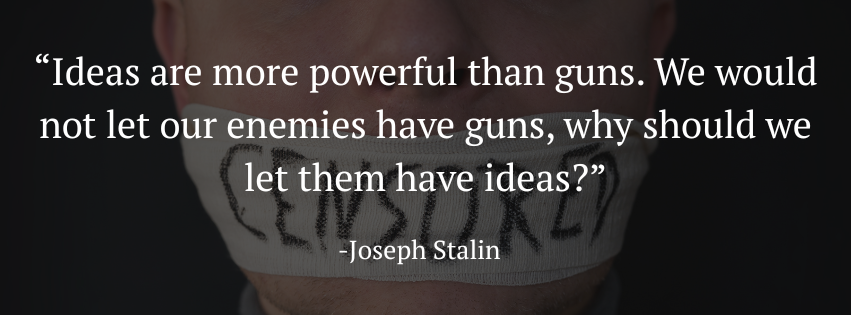
The human cost of Stalin's enforced monologue was catastrophic: beyond the systematic silencing of dissent and free speech, an estimated 20 million people died under his regime due to executions, forced collectivization, labor camps, and famine (Miltimore & Reed, 2023).
To fully understand the forced alignment trap, picture yourself in 1920s Soviet Russia. Under the tightening grip of Stalinist ideology, the state flattened human complexity into rigid, controllable units. Investigation, debate, and the free exchange of opinions were strictly taboo (Falk, 1946; Popan, 2022). Institutional monologues demanded absolute compliance with a singular state reality.
Linguist and philosopher Mikhail Bakhtin looked at these violent attempts to sanitize social life and chose to resist. At great personal risk, Bakhtin (1986) argued that meaning does not reside in a state-sanctioned history book or a single leader's head. Instead, consciousness and meaning are continually co-created in the dialogic space between people when they interact.
Bakhtin described communication as a continuous, never-ending chain of speech communion (1986, p. 94). Every word we utter is just one link in an ever-lengthening chain—deeply entangled with what has already been said and what we anticipate others will say in return.
When leaders or stepparents try to cut this chain short by forcing alignment, they act as microcosmic mirrors of a totalitarian apparatus: trying to force a monologue onto a world that is inherently multivocal and dialogic. (And no, this is not your free pass to call your boss a dictator! At least…not at work).
Relational Dialectics Enters the Chat
In 1996, University of Iowa professor Dr. Leslie Baxter and Colorado State University-Pueblo colleague Barbara Montgomery reviewed the landscape of communication research and found it rife with similarly rigid, mechanistic thinking. Dominant psychology treated relationships like predictable, linear stages moving toward a stable "center" with “closeness” as the central objective (Baxter & Montgomery, 1996).
Drawing inspiration from Bakhtin, they rejected theories that claimed to neatly standardize and predict human communication. As social constructionists, they argued that meaning is fluid, multivocal, and shaped by context (Kretchmar, 2019). Humans don’t simply use talk to transmit messages; the talk we give and hear about relationships shapes who we are (Baxter, 2011, p. 19). And, though we might find it unsettling, they didn’t believe the “goal” of relationships was necessarily a “return to center.”

Cartoon by Scott Metzger
RDT 1.0 vs. RDT 2.0
In its 1.0 iteration, Baxter and Montgomery (1996) mapped the basic psychological contradictions we experience in one-on-one relationships:
Integration vs. Separation: The pull to be close vs. the need for space.
Stability vs. Change: The comfort of routine vs. the thrill of novelty.
Expression vs. Privacy: The urge to share everything vs. the need for boundaries.
However, to ensure RDT wasn't confused with mere internal mood swings, Baxter (2011, p. 10) upgraded the framework to RDT 2.0. She swapped the term contradictions for discursive struggles—the active clash between broader interpersonal and cultural discourses competing for dominance over meaning.
Alongside researchers like Dawn Braithwaite, the theory expanded from couples to complex family systems (Braithwaite & Baxter, 2006). Among its many applications, RDT became a powerful diagnostic tool for mapping how stepchildren navigate the intense structural friction of the "already-spoken"—the invisible cultural scripts and deep-rooted biological loyalties that collide with the presence of a new stepparent.
The Dialogic Link to Leadership
As it turns out, an employee navigating a massive corporate restructuring experiences a parallel structural friction (Hoelscher, 2019). Resistance to new software, standard operating procedures, or reporting structures is rarely the result of pure stubbornness. Instead, it points to a struggle with the "already-spoken"—a tug-of-war between honoring the legacy systems that historically built their success and embracing the innovation required to move forward.
When leadership defaults to centripetal force—demanding alignment with the dominant discourse—centrifugal forces (i.e., marginalized voices) do not disappear (Baxter, 2011, p. 22). They simply drive underground, mutating into passive-aggressive resistance, group infighting, or quiet quitting.
True change leadership means rejecting the myth of the top-down monologue that defaults to dominant scripts. It requires stepping into the role of a dialogic facilitator—someone who realizes that friction isn't a personality defect to be corrected, but a dynamic tension to be skillfully navigated to achieve the best possible outcomes for all involved.
So, how do you actually apply this theory to a discursive struggle that explodes in your face?
Grab a drink. In Part 2, you’ll see behind the scenes of that time I got disinvited from my stepson’s wedding—and how it inspired me to use RDT to become a better strategic communicator, leader, and stepmama.
References
Bakhtin, M. M. (1986). Speech genres and other late essays (V. W. McGee, Trans.; C. Emerson & M. Holquist, Eds.). University of Texas Press.
Baxter, L. A. (2011). Voicing relationships: A dialogic perspective. SAGE Publications. https://doi.org/10.4135/9781452230344
Baxter, L. A., & Montgomery, B. M. (1996). Relating: Dialogues and dialectics. Guilford Press.
Braithwaite, D., & Baxter, L. (2005). Relational dialectics theory: Multivocal dialogues of family communication. In Engaging theories in family communication : Multiple perspectives. SAGE Publications, Inc. https://doi.org/10.4135/9781452204420
Braithwaite, D. O., & Baxter, L. A. (2006). "You're my parent but you're not": Dialectical tensions in stepchildren's perceptions about communicating with the nonresidential parent. Journal of Applied Communication Research, 34(1), 30–48. https://doi.org/10.1080/00909880500420200
Falk, L. (1946, December 2). Intellectual elbow room strictly taboo in Russian schools. Labor Action, 10(48), 5. Marxists Internet Archive. https://www.marxists.org/history/etol/writers/jacobson/1946/12/staleduc.htm
Hoelscher, C. S. (2019). Collaboration for strategic change: Examining dialectical tensions in an interorganizational change effort. Management Communication Quarterly, 33(3), 329–362.
Kretchmar, J. (2019). Social constructionism. In Research starters: Education. Salem Press.
Miltimore, J., & Reed, L. W. (2023, March 8). Joseph Stalin in his own words. Foundation for Economic Education. https://fee.org/articles/joseph-stalin-in-his-own-words/
Popan, J. (2022). Stalinism. In EBSCO Research Starters. EBSCO. https://www.ebsco.com/research-starters/political-science/stalinism