
When Change Initiatives Backfire: That Time I Got Disinvited from A Wedding (Part 2)
Early in my communications career (when I was still high on idealism), I facilitated a workshop to align senior executives with department communication leads for a multistakeholder initiative. On the surface, we easily shipped the company’s first-ever mission report. I was so proud of us! What I didn’t know? A senior manager with twenty years of tenure was furious that she wasn't leading the charge—and she wasn’t about to let that happen again.
The following year, our once smoothly run project devolved into the communication style affectionately known as "Seattle nice"—surface-level politeness blended with equal parts passive aggression, like the sugary-sweet yet burnt taste of a Starbucks drink. Project execution got stuck in the feud between the company’s legacy functional hierarchy (built on title and tenure) and our new projectized environment (built on collaboration and skill).
Years later, I found myself in the exact same psychological situation—but this time, instead of navigating unspoken corporate politics, I was chin-deep in becoming a stepmother to young adult children. Same struggle, different arena.
That Time I Was Disinvited from a Wedding, AT A WEDDING
The transition was seamless at first. My oldest stepson told me pointblank he accepted me as his dad’s new wife (whoa!). He invited me to his upcoming wedding, asked for my marketing advice, and followed me on Instagram. If you’re a stepparent, you know: these small moments of acceptance are massive victories. I clocked them as a permanent reality. I had won stepmotherhood!
Then came the weekend he and his fiancée visited us.
The atmosphere shifted instantly. They stuck to themselves and barked back with sly remarks anytime they perceived an inconvenience—especially when we mentioned they might need to pick up their grandma while we dealt with a neighborhood water main leak. Things came to a head at a family wedding we were all attending. Most guests were outside playing lawn games while the happy couple got photos, so I took advantage of a moment alone with them to hash it out.
The conversation went nowhere fast. I pushed for openness; they pushed to stay closed. He called me “rude.” Within minutes, my stepson and his fiancée were swearing and storming off, while she declared me “the rudest person they had ever met.” The final blow? I was officially disinvited from their wedding.
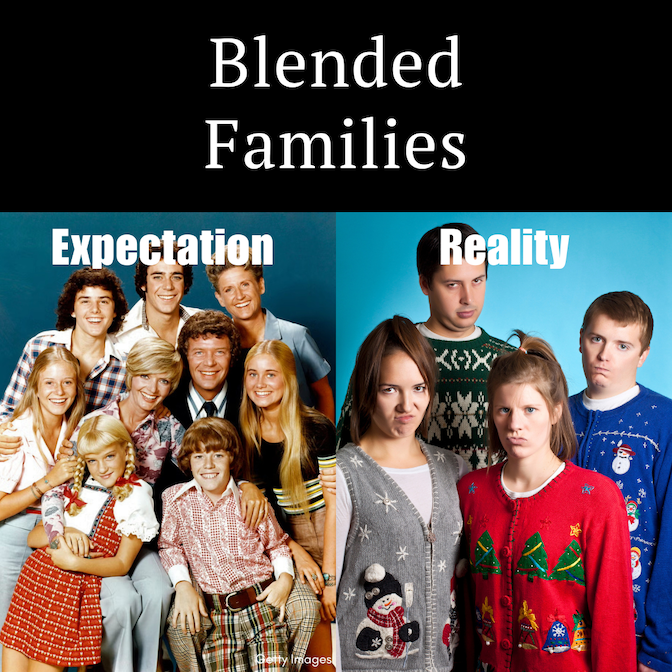
My project-manager brain kicked into overdrive: Fix it. Run a root-cause analysis. Realign roles and responsibilities. Too, my ego desperately wanted to mount a defense campaign, complete with a masterclass monologue on mutual respect (which I may have drafted in my Notes app…multiple times).
But cooler heads had to prevail (damn this adulting). So I forced myself to get curious and look for an answer: What was he and his fiancée actually reacting to?
Decoding the Friction: Talk as Data
As researchers Braithwaite and Baxter (2006) point out, stepfamilies are a living laboratory of intense structural friction—and what’s on the surface is rarely the full story. So when my stepson pulled that invitation, he wasn’t simply mad about a superficial misunderstanding.
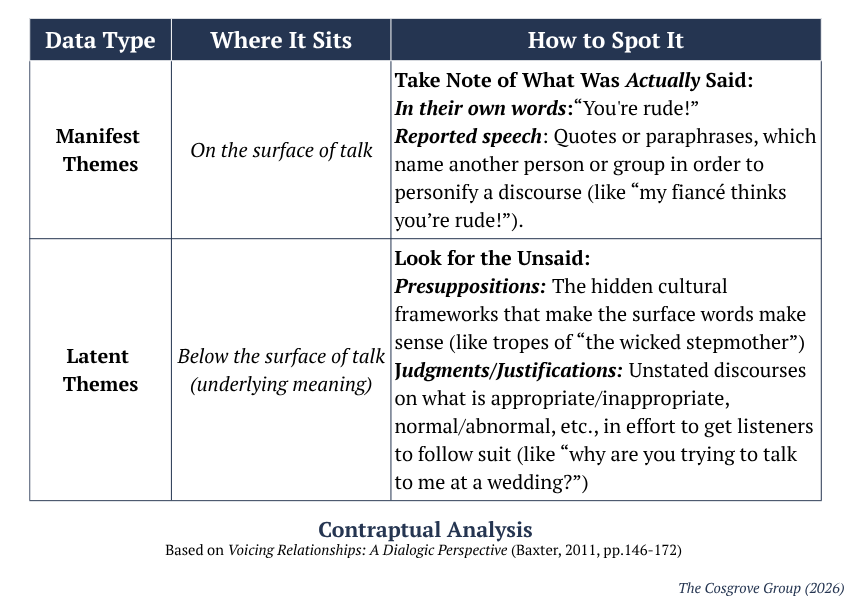
To a Relational Dialectics (RDT) theorist, talk (even harsh words) isn't just noise—it's qualitative data. To decode it, researchers use Contrapuntal Analysis (Baxter, 2011), an interpretive approach that looks past the surface to see how meaning is split across two fronts: Individual Identity (Who am I in this relationship?) and Relationship Identity (Who are "we"?).
To extract these meanings, we have to analyze two distinct thematic layers:
Unfolding the Wedding Blowout
To analyze data inductively, we have to "unfold" the utterance by treating a defensive explosion not as an isolated event, but as a link in a historical chain (Bakhtin, 1984).
When we look at my stepson's outburst, the data reveals a deeper story:
The Manifest Layer: His fiancée’s surface talk explicitly brought his perspectives and historical grievances into the argument. They used the surface text to establish a hard boundary to protect their individual autonomy and their unit as a couple.
The Latent Layer: As Baxter (2011, p. 154) instructs, I had to ask: What unstated discourses of propriety are being invoked here? Analyzing his stance through Appraisal Theory (Martin & White, 2005) made it clear that he was caught in a severe loyalty conflict. His biological mother had recently gone through a bad breakup, and he was operating from a heavy, invisible cultural script dictating that a loyal son must protect his biological mother (in this case, from the awkwardness of meeting her ex-husband’s new partner for the first time at her son’s wedding).
By pulling the wedding invitation, they deployed a dialogic contraction (Baxter, 2011, p. 18). They violently narrowed the conversation to a forced monologue—Sarah is bad—because it was the only way to protect my stepson’s legacy family culture from the disruptive new interpersonal "miniculture" we had been building together (Wood, 1982).
The Corporate Parallel: Listening for the Unsaid
When a change initiative backfires in the workplace, we are witnessing the exact same human script. When a veteran employee lashes out at a new Smartsheet dashboard or intentionally drags their feet on a new operational process, they are rarely just being a "detractor." They are providing you with critical text.
If you only listen to the manifest data, you’ll just hear complaints about change fatigue (Agócs, 1997). But run a contrapuntal analysis on their pushback, and you decode the latent data:
Discourses of Propriety (i.e., “The Right Way”): Look closely when employees offer justifications for their actions. Because people naturally justify inappropriate actions rather than appropriate ones (Baxter, 2011, p. 154), their excuses can reveal what they believe the "right" way of working was. The only catch? Resist going straight for the label of “personality issue” and work to understand what discourses may be forming their excuses.
The Loyalty Bind: Get curious about how their resistance may be acting as a latent defense mechanism. They may be torn between the legacy functional hierarchy (which gave them their professional identity and tenure) and the innovative new structure that threatens to disrupt comfortable processes, destabilize their positions, or even decentralize their authority.
When a team member forces a dialogic contraction by shutting down, stonewalling, or lashing out, they are likely panicking—desperately trying to flatten a complex tension into a simple monologue where their legacy success and comfort remain safe.
The Leader’s Achilles Heel: Competing for the Last Word
Rushing to "resolve tension" or force immediate alignment is the fastest way to trigger a corporate dialogic contraction. When we treat an explosive boundary or stubborn excuse as a personality or performance issue, we miss the underlying structural friction entirely.
When a sudden contraction hits, you essentially have two choices:
The Centripetal Reaction: Double down on authority (“I’m the real adult here!”), execute a counter-contraction, and demand alignment. (Spoiler: This just drives the resistance deeper underground, setting up an even bigger explosion later).
The Dialogic Facilitation: Treat the explosion as critical relational and operational data, step off your soapbox, and prepare to hold space for competing perspectives and centrifugal voices—that a new, shared meaning might arise.
What happened after the wedding ban? In the final installment of this series, you’ll learn how I dealt with the aftermath of the “rudest person ever” comment—and explore specific communication strategies you can use to navigate leadership—and life's—inevitable relational frictions.
References
Agócs, C. (1997). Institutionalized resistance to organizational change: Denial, inaction and repression. Journal of Business Ethics, 16(9), 917–31. https://doi.org/10.1023/A:1017939404578
Bakhtin, M. M. (1984). Problems of Dostoevsky's poetics (C. Emerson, Ed. & Trans.). University of Minnesota Press. (Original work published 1963).
Baxter, L. A. (2011). Voicing relationships: A dialogic perspective. SAGE Publications.
Braithwaite, D. O., & Baxter, L. A. (2006). "You're my parent but you're not": Dialectical contradictions in stepfamilies. In J. Turner & R. West (Eds.), The SAGE handbook of family communication (pp. 245–266). SAGE Publications.
Martin, J. R., & White, P. R. R. (2005). The language of evaluation: Appraisal in English. Palgrave Macmillan.
Wood, J. T. (1982). Communication and relational culture: Bases for the study of human relationships. Communication Quarterly, 30(2), 75–83. https://doi.org/10.1080/01463378209369432