
Change Leadership in Action: Holding Space for Dissensus, New Meanings, and the Unity of Opposites (Part 3)

In the world of communication management, the most dangerous move you can make during an active crisis is to let your ego dictate the response strategy—which is far easier said than done when your or your organization’s reputation is on the line. That’s why when my stepson pulled my wedding invitation, every primal instinct I had—from fear to anger to grief—wanted to fight back, realign our expectations, and restore my good standing.
But my professional background in crisis communication pulled me back from the ledge. I knew the data: matching a dialogic contraction with defensive pushback is a fast road to lasting reputational damage (Ye & Ki, 2018). If the first rule of crisis communication is picking the right strategy for the structural reality (Coombs, 2006), then the correct strategy here was to be the one who took the first step toward cooling hostilities. I chose to suspend action (Hoelscher, 2019) and step entirely out of the frame. I opted to use my flight from Spokane to Denver as the first leg of a trip to see my parents in New Mexico, leaving my partner and his immediate family to attend the event without me. I chose to let the tension exist, pausing our familial integration so that a new kind of meaning could eventually be built. I chose to get curious on my role in the conflict—and what compassion, for each and both of us, might look like.
Constructing New Meaning: The Aesthetic Moment

In Relational Dialectics Theory (RDT), when you stop treating competing discourses as an "either/or" war, you open yourself to experience Baxter (2011) calls an aesthetic moment—a multivocal meeting that honors and converge your wholeness with another’s (Bakhtin, 1990, p. 25-27). Now, this isn't a permanent, fairy-tale ending where all tension magically evaporates. But it is a temporary, beautiful alignment between two or more distinct voices, no longer framed as competitive—but rather, mutually compassionate and inherently unique yet intertwined (p. 34).
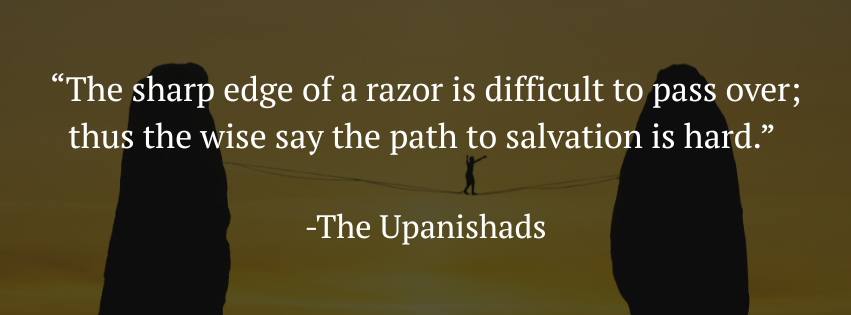
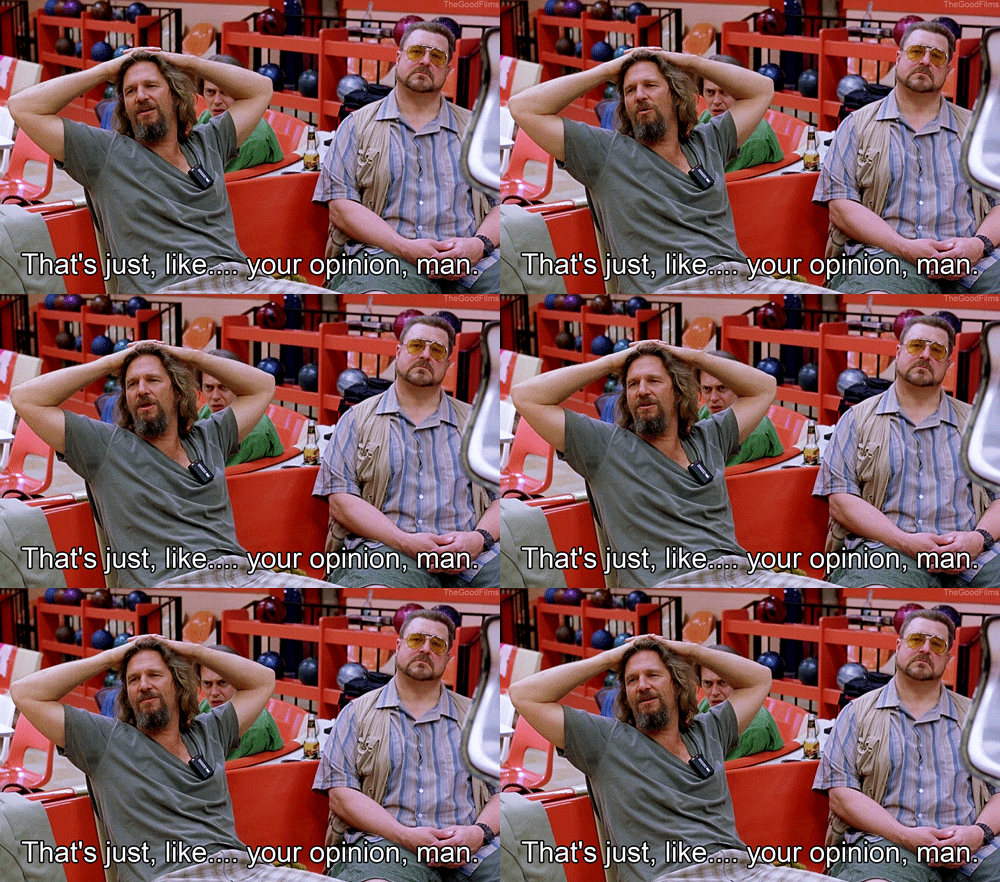
Drawing inspiration from German-Jewish philosopher and theologian Martin Buber, RDT encourages us to find the “narrow ridge”—the dynamic, liminal space situated right between the moral laxity of relativism (“it’s all relative” or, as the Dude might say it, “that’s just like…your opinion, man”) and the moral rigidity of absolutism (“it’s my way or the highway!”).
On this narrow ridge, we are able to honor both “the discourse of individual identity and the discourse of interpersonal responsibility” (Griffin et al., 2023, p. 146). For RDT theorists—and perhaps, you too—communication and conflict are thus reconceptualized as sites for productive creativity and empathy; by refusing the pull of either extreme, entirely new meanings can be constructed (Baxter, 2011, p. 110).
By stepping back, my stepson was no longer forced into a painful, binary choice between his "old" legacy family (past/stability) and his "new" blended family (present/change). He didn't have to betray his biological mother to be a good son. Instead, he got to voice previously unexpressed feelings of grief to his dad—confiding a tender pain that things would “never be the same”—and navigate his wedding without the added layer of integrating “legacy with innovation.”
For me, the transformation was equally profound. I realized that a successful blended family doesn't mean we all have to structurally sit at the same physical table for every single life event to prove "we are unified." Family unity can be dynamic, fluid, and quietly supportive from a distance. The tension stopped hurting the moment we allowed it to just exist—and the counter-offensives got traded for compassionate curiosity.
The Real Value (and Limitations) of RDT
Relational Dialectics Theory isn’t predictive—it won't calculate exactly when a subtext will strike a nerve or a conflict will boil over into a crisis. Instead, its power lies in its heurism [insightfulness into human communication] (Baxter, 2011, p. 15). It forces us to move away from the safety (and ego highs) of top-down monologues and listen to a plurality of perspectives, especially marginalized discourses. It provides a diagnostic lens to see that relationships are inherently messy and non-linear, transforming how we interpret—and leverage—the noise of human friction.
Key Takeaways for Organizational Leaders
The exact same communication dynamics that govern the living room dictate success or failure in the conference room. When leading massive organizational restructurings, digital overhauls, or process pivots, leaders can deploy three strategic alternatives to the centripetal force of dominant discourses and top-down monologues:
1. Diagnose the “Loyalty Wedge”
In corporate change initiatives, the "biological parent" is often the legacy leadership, the dominant culture, or the old software system that the team spent years mastering.
Employees rarely resist a new project management tool like Smartsheet or Monday.com just because they are being "difficult." Often, they are caught in a latent loyalty bind. Adopting the new system feels like an implicit betrayal of the old system—from their roles to their team—that historically brought them success and meaning.
The Strategy (Acknowledging): To bypass a defensive dialogic contraction, leaders must explicitly deploy the communicative strategy of acknowledging (Hoelscher, 2019). Name the legacy system's value openly, and allow your team to do the same. Honoring these feelings prevents them from mutating into passive-aggressive resistance. For example, "Our legacy tracking processes are what got us here, and the work you put into them was vital. We aren't throwing that away. We are building upon its strengths."
2. Read Process-Based Friction
Surface-level bickering over minor project details or software glitches is rarely actually about what’s on the surface. It is almost always a defensive closure hiding unvoiced anxieties about authority, competence, or role security.
When a corporate restructuring introduces a new change management project lead alongside a legacy department head, employees experience a severe freedom-constraint and authority dialectic. They are trapped between competing directives, trying to find their place in a shifting hierarchy.
The Strategies (Hedging & Delaying): Rather than demanding immediate, blind compliance, master two tactical communication tools:
Hedging: Deploying vague framing to give competing internal factions a sense of security while the structural dust settles: “During this transition, our primary goalis maintaining continuity of care. Teams are encouraged to leverage the new dashboard at a pace that respects capacity, butwe won’t fully transition until everyone has had time to adjust."
Delaying: Temporarily suspending action when emotions run high to prevent a permanent breakdown in collaboration (Hoelscher, 2019): “We are hitting some fundamental structural friction here, and it’s clear we have competing, valid organizational needs. Let's hit pause on this specific roll-out discussion, look at the data independently, and reconvene next Thursday to map out a path that honors both efficiency and team autonomy."
3. Move from Monologue to Dialogic Facilitation
Mandating compliance does not erase structural friction—it simply drives it underground, creating a toxic, passive-aggressive environment where strategic initiatives go to die.
Instead of forcing a top-down monologue, great leaders step off their soapboxes and look at pushback as valuable relational data. By openly validating that two (or more) opposing organizational needs can all be completely legitimate (e.g., the need for fast-paced innovation vs. the need for stable operational infrastructure), you transform a potential breakdown into a generative, multi-voiced space.
The Unity of Opposites

True change leadership requires leaning into what Baxter (2011) calls the unity of opposites (p. 26). Innovation cannot exist without a stable foundation to disrupt; change cannot be measured without a baseline of stability. They are not enemies—they require one another to exist.
When the inevitable explosion hits your team, your department, or your family dynamic, don't rush to silence the dissenting voice, climb onto an defensive soapbox (admittedly, still a work in progress for me), or force a premature resolution. Step back, breathe, decode the latent data, and create space for marginalized voices. Friction isn't a sign that your leadership is failing—it’s the exact place where meaningful, lasting transformation is eager to be born.
References
Bakhtin, M. M. (1990). Author and hero in aesthetic activity. In M. Holquist (Ed.), Art and answerability: Early essays by M. M. Bakhtin (V. Liapunov, Trans. pp. 4–256).
Baxter, L. A. (2011). Voicing relationships: A dialogic perspective. SAGE Publications.
Boyle, G. (2010). Tattoos on the heart: The power of boundless compassion. Free Press.
Buber, M. (1965). Between man and man (R. G. Smith, Trans.). Macmillan.
Coen, J. (Director), & Coen, E. (Director). (1998). The big Lebowski [Film]. PolyGram Filmed Entertainment; Working Title Films.
Coombs, W. T. (2006). The protective powers of crisis response strategies: Managing reputational assets during a crisis. Journal of Promotion Management, 12(3–4), 241–260. https://doi.org/10.1300/J057v12n03_13
Encyclopædia Britannica editors. (2018, May 17). The razor's edge. Encyclopædia Britannica. https://www.britannica.com/topic/The-Razors-Edge-novel-by-Maugham
Griffin, E. A., Ledbetter, A., & Sparks, G. G. (2023). A first look at communication theory (11th ed.). McGraw-Hill Education.
Hoelscher, C. S. (2019). Collaboration for strategic change: Examining dialectical tensions in an interorganizational change effort. Management Communication Quarterly, 33(3), 329–362.
Ye, L., & Ki, E.-J. (2018). Impact of message convergence on organizational reputation: An examination of organizational crisis communication on Facebook. Corporate Reputation Review, 21(1), 1–8. https://doi.org/10.1057/s41299-017-0040-5