

Transgressive Pedagogy: Dialogic Co-Creation, Critical Praxis, and Cura Personalis
Jump to:
Introduction • My Why •My Philosophy • Learning Outcomes • Assessment • Conclusion
My journey into communication and media studies began as a freshman in college, when I got a job as a peer educator for a campus program dedicated to alcohol harm-reduction, campus sexual assault prevention, and media literacy. Though this was an exciting opportunity and aligned with my values of serving others, I was also painfully shy—and terrified of public speaking. Though thanks to mentorship from program leaders and a freshman communication class focused on public speaking, I soon gained confidence to speak in front of my fellow college students and faculty. After three years, I moved to a local sexual assault services nonprofit serving southern New Mexico, where I presented to over 8,000 people of all ages through over 350 presentations in two years. Later, I became a yoga teacher (currently at over 1,350 hours of teaching) and sought training and certification in teaching trauma-sensitive yoga, an “empirically validated clinical intervention for complex trauma or chronic, treatment-resistant post-traumatic stress disorder (Center for Trauma and Embodiment, n.d.). Throughout the past 15 years, I’ve had the privilege of teaching these practices through classes and workshops at studios, gyms, a domestic violence shelter, a county jail, at a public school program for youth experiencing homelessness, at a nonprofit serving people with Down syndrome, and as Yoga Faculty at Oregon Coast Community College.
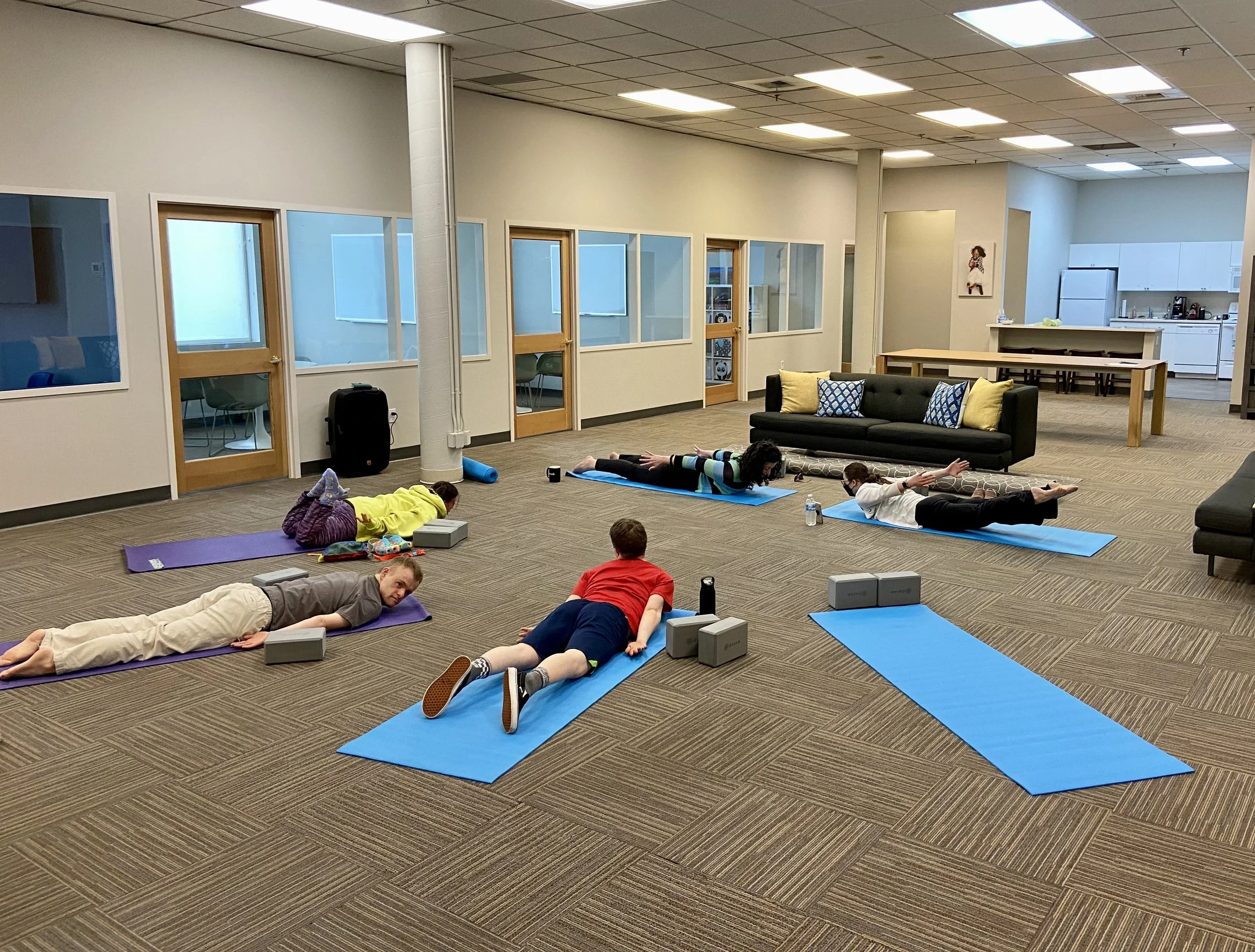
Sarah (back, center) leading a weekly class—Yoga Dance Party!—for young adults with Down syndrome at the Down Syndrome Center of Puget Sound in Seattle in 2021.
If someone told 18-year-old me that one day I would have thousands of hours of public speaking, teaching, and facilitation experience under my belt one day, I would have laughed—and cried inside, terrified. My family's social location and some hard life experiences meant our voices and presence hadn't been front and center for most of my life, but rather quietly working as the "unskilled labor" behind the scenes. Though he never attended college, my dad is a brilliant man—an Hispano educated in the rhythms of nature and seasonal migrant work and the first generation in his family to speak English and move to the city. My mother, the first generation born in Northwest England to first-generation Northern Irish Catholic immigrant parents, is equally bright, despite having an eighth-grade education. We all feel some semblance of pride and a quiet grief when I speak in a voice that feels at once familiar and foreign, another manifestation of our family’s many “first generations.”

Behind the Ivory Curtain: Deconstructing Power, Persuasion, and Media Messages
As a small-town, first-generation college student raised by working-class parents, my experience in higher education was my first transformative exposure to naming systemic power dynamics, practicing written and oral persuasion, and applying media literacy to everyday life and social issues. Along with serving as the foundation for my career, these early communication studies enabled me to feel confident using my voice, make sense of structural issues, and develop a lifelong passion for critical analysis and argumentation. Because of this, I want to teach students that rhetoric and media must be deployed and consumed critically, as personal, relational, and communal responsibilities that can be leveraged to advance social good.

My primary motivation as an educator is to help students recognize how power functions through discourse, deconstruct how media messages operate, and ethically harness their own voices for the public good—such as boldly speaking up against the genocide in Palestine..
Throughout my time as a sexual assault prevention educator, college professor, and yoga instructor, I have been able to return the kindness and faith shown me, supporting students through their own personal journeys of awareness, transformation, and empowerment. I have also had the privilege of advocating for equity, systemic change, and critical thinking about the messages we continually receive through dominant cultural storytellers about what is right or true—so that students learn not merely to be passive consumers and creators of culture, but to see themselves as agents of both social sustainability and change.
Like many first-generation students, I have found that education—and the many, multifaceted teachers who contributed to my learning—has enabled me to accumulate more embodied and institutional cultural capital than my parents—and choice on how I will use it. As bell hooks (1994) offers in Teaching to Transgress, “To educate as the practice of freedom is a way of teaching that anyone can learn. That learning process comes easiest to those of us who teach who also believe that there is an aspect of our vocation that is sacred; who believe that our work is not merely to share information, but to share in the intellectual and spiritual growth of our students” (p. 13).
In my teaching practice, I choose the practice of freedom—especially from interlocking political, economic, and social systems like imperialist white-supremacist capitalist patriarchy (hooks, 2004)—that perpetuate generational harm, extraction, and inequity for the power and profits of the few. A better world is possible for all of us—and will only be possible through communication, which is central to “all human action” (Fernback, 2014, p. 1). Through my practice—never a finished product, but a perpetual work in progress—I focus on supporting those with less access and opportunity to embody their voice, while guiding those with more social, cultural, and material capital to examine their power and the current systems that automatically favor those like them. I teach so that we might all open our minds and hearts to “know beyond the boundaries of what is acceptable, so we can think and rethink, so that we can create new visions” (hooks, 1994, p. 12). Through courses in public speaking, interpersonal communication, strategic communication, and yoga, my goal is to help teach students the invaluable life skills of empathy, critical thinking, active listening, power sharing, media literacy, conflict resolution, and strategic storytelling that influences positive change.
As Dannels (2014) writes, “teaching is fundamentally relational and communicative” (p. 17). Over the past two decades, I’ve repeatedly lived this truth across my work as a community educator, crisis advocate, yoga instructor, and strategic project manager. Guided by these experiences, my core motivation for teaching is to co-create liberating, inclusive learning spaces where students can explore communication as the common ground of all human action (Fernback, 2014, p. 1) and recognize their own agency as knowledge and communication producers, critical thinkers, and society shapers.

The Teacher’s Role: Student, Mentor, Coach, Advocate, and Occasional Comedian

The communication educator must continually examine relational and structural power dynamics—including their own within the classroom—and embody leadership that resists hegemonic top-down hierarchies.
As Fernback (2014) highlights, “Human and mediated discourses serve or resist extant power perspectives, and these processes must be examined from critical and ethical perspectives [...] Subjugating ourselves to such examination is a difficult but necessary by-product of teaching communication and media studies” (p. 7). Paulo Freire (1970) characterizes this dialogic relationship as forming new meaning: “Through dialogue, the teacher-of-the-students and the students-of-the-teacher cease to exist and a new term emerges: teacher-student with students-teachers” (p. 80).
“I view the role of ‘teacher-student with students-teachers’ as multivalent: a forever student of self and subject; a mentor who models skills; a coach who encourages students to construct their own conclusions through research, critical thinking, and experiential learning; an advocate for respect and justice, inside and outside the classroom; and an authentic human who creates memorable, communal experiences through inclusion, humor, and storytelling.”
This approach aligns with several educational philosophers, including Freire, Neil Postman, Charles Weingartner, John Dewey, Ignatius Loyola, and Parker Palmer. Freire (1970) rejected the “banking model” of education—where students passively receive information deposits from their teacher—and instead promoted critical consciousness through “dialogical and problem-posing education” (p. 40). Postman and Weingartner (1969) proposed a parallel framework, where the teacher’s primary role is to help students cultivate critical inquiry to question institutional norms, interrogate media ecology, and challenge systems of injustice and oppression—or, as they frame it, help students become “experts at ‘crap detecting’” (p. 3). Dewey’s (1938) pragmatism grounds these critical traditions into experiential practice, emphasizing “the organic connection between education and personal experience” (p. 25) and intellectual growth through reflection and self-directed reconstruction (p. 64). Finally, Palmer (1998) states that wholeness comes from integrity and that “good teaching comes from the identity and integrity of the teacher”, while Ignatian pedagogy (International Commission on the Apostolate of Jesuit Education, 1993) promotes “alumnorum cura personalis, a genuine love and personal care for each of our students” (p. 36). Together, these educational traditions encourage teachers to embody authenticity and integrity, cultivating environments where students feel safe, self-aware, and supported to engage in transformative, experiential learning.

Goals and Objectives: Learning Outcomes Across Levels and Subjects
To care for the whole person (cura personalis), setting and assessing goals and objectives should account for students’ diverse life contexts, personal experiences, and academic and professional trajectories across course levels:
Lower-Division Undergraduate (e.g., Public Speaking, Intro to Communication): The goals are to make communication relevant, nurture embodied confidence, and build a critical foundation. Objectives focus on developing core disciplinary vocabulary, active listening and empathy, and interpersonal communication (e.g., teamwork). Students demonstrate competency by mapping their daily reliance on communication, delivering clear but kind peer reviews, analyzing trending media artifacts in small groups, and writing reflective self-assessments on speech anxiety and somatic regulation techniques.
Upper-Division Undergraduate (e.g., Persuasion, Media Literacy, UX Writing): The goals expand to theoretical foundations, critical interrogation, ethical analysis, and tactical execution. Students deconstruct how power and rhetoric operate within interpersonal relationships, institutions, and complex media ecosystems. Objectives challenge students to apply theory to critical media analyses, execute comparative persuasion campaigns, and design customer-facing deliverables, like UX copy.
Graduate and Career Learning (e.g., Pedagogy, Change Leadership): Integrating scholarly and professional knowledge (Fernback, 2014, p. 4), the goals for graduate and adult education are reflective praxis (Dewey, 1938), organizational communication, and teaching as a discipline based in research and student learning (Fernback, 2014, p. 5). Rooted in dialogic co-creation (Freire, 1970), learning objectives leverage student and peer professional experience to bridge theory and research with communication initiatives for organizational change. Students work independently and collaboratively on research projects, facilitate interactive workshops, and create a professional portfolio.

Assessment as Experiential Praxis and Continuous Dialogue
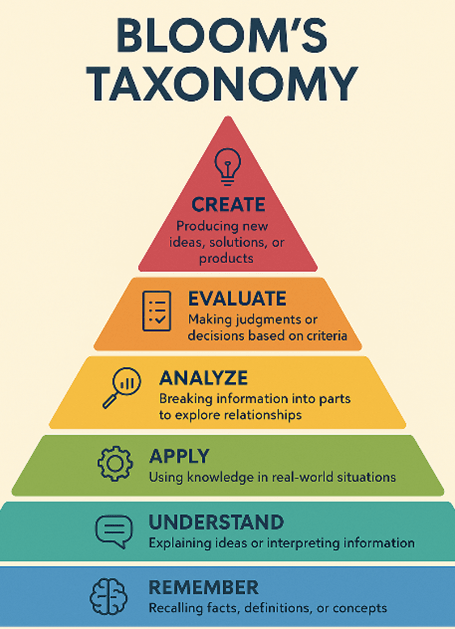
In alignment with Freirean dialogue (Freire, 1970) and Ignatian evaluation, I approach assessment as an ongoing conversation focused on “growth in attitudes, priorities, and actions” that includes and extends beyond academic mastery (ICAJE, 1993, p. 19) . Student learning is systematically evaluated through both formative and summative assessments (Carnegie Mellon University, n.d.), structured to guide an increasing movement through Bloom's taxonomy—Remember, Understand, Apply, Analyze, Evaluate, and Create—specifically for media and communication studies (Fernback, 2014, p. 57).
Source: CommLab India
Early and ongoing formative check-ins target foundational lower-level cognitive processes (remembering, understanding, applying communication concepts), while summative assignments and projects serve to encourage the actionable integration of higher-level cognitive complexity (analyzing media structures, evaluating communication products and processes, and creating original communication and media forms).
Guided by transparent and accessible grading rubrics, assessments include:
Self-Evaluation: Metacognition is evaluated through reflective writing assignments “which foster attention to experience, reflective understanding beyond self-interest, and criteria for responsible action” (ICAJE, 1993, p. 20).
Co-Creative Dialogue: Ongoing informal and periodic formal check-ins are used to gauge comprehension and pivot instruction based on student questions and needs.
Tangible Deliverables: Skill development is primarily evaluated through practical, relevant assets—such as pitch decks, campaign mockups, or media analysis.

Conclusion
My teaching philosophy is anchored in the belief that the role of communication and media studies education is to serve the whole person, build new political, economic, and social systems, and ultimately co-create a better world for all—one person at a time. Guided by hooks’s transgressive teaching, Ignatian cura personalis, Freirean critical consciousness, Deweyan experiential learning, Postman’s “crap-detecting” critical inquiry, and Palmer’s call for an academic identity of integrity, I cultivate co-creative, dialogic, and relational classrooms where power is shared and students honor their own and each other’s agency. As I intentionally honor my family’s “first-generation” journey and our ancestral stories—the colonizer and the colonized; the oppressed and the oppressor—I strive to co-create critical, feminist, and social constructivist spaces where students know, learn from, and build upon the unique contexts of their own lives (ICAJE, 1993, p. 19) to create new meanings and ways of being. No matter who or what I teach, my objective as an educator is to help students grow into self-aware, articulate, compassionate, and collaborative communicators—empowered to honor their roots and unfolding story, critically consume and create media, challenge oppressive hegemony in leadership, and advocate for a more just, equitable world.

References
Center for Trauma and Embodiment. (n.d.). Trauma Center Trauma-Sensitive Yoga (TCTSY). JRI. https://www.traumasensitiveyoga.com/
Dannels, D. (2014). Eight essential questions teachers ask: A guidebook for communicating with students. Oxford University Press.
Dewey, J. (1938). Experience and education. Macmillan.
Fernback, J. (2014). Teaching communication and media studies: Pedagogy and practice (1st ed.). Routledge.
Freire, P. (1970). Pedagogy of the oppressed. Herder and Herder.
hooks, b. (1994). Teaching to transgress: Education as the practice of freedom. Routledge.
hooks, b. (2004). The will to change: Men, masculinity, and love. Washington Square Press.
International Commission on the Apostolate of Jesuit Education. (1993). Ignatian pedagogy: A practical approach. Jesuit Institute.
Palmer, P. J. (1998). The courage to teach: Exploring the inner landscape of a teacher's life.
Jossey-Bass.
Postman, N., & Weingartner, C. (1969). Teaching as a subversive activity. Delacorte Press.